Showing posts with label Uganda. Show all posts

Sunday, September 11, 2011

The black mamba

One the scariest moments in Shankar's days in the grasslands of East Africa was his night-time encounter with the black mamba.

According to Wikipedia, its name is derived from the black colouration inside the mouth rather than the actual colour of the skin which varies from dull yellowish-green to a gun-metal grey. It is the fastest snake in the world, capable of moving at 4.32 to 5.4 metres per second (16–20 km/h, 10–12 mph).

This is a really really dangerous creature. How danger can be appreciated when you read this post by Wade Nolan. "On a recent safari to Africa, I hand-caught a wild nine-foot Black Mamba. It was a calculated risk...involving bad calculation.
The Mamba's head is coffin-shaped and the inside of his mouth is an ominous black...he would raise up to near eye level, look aggressively at us then loose his balance... and tip over...only to raise up again..hissing. I thought that maybe he had gotten hold of a bad mouse and was woozy.
I made a hasty and misguided decision to lay hands on the most poisonous snake in the world. Most mamba bites are fatal.  This aggressive cobra has a nasty habit of biting it's victims 4 and 5 times in the face and neck.
The third time he raised up and tipped, I pinned his head, and without a lot of thinking...(I bet that surprises you), I had a very angry Black Mamba in my hand.

From the roof of his gaping open mouth I could see the curved extended fangs. Dripping from those fangs was the deadliest venom in the reptile kingdom... mamba venom is yellow. The slippery venom ran out of the corner of his mouth and into my hand..." 

There's a pretty hairy video of this episode here.
And here's a vid of a black mamba hunting a mouse. A friend said that this is the first time she felt sympathy for a mouse.


Monday, August 22, 2011

The man-eating lions

In "Mountain of the Moon", the workers building the railway are bedevilled by a pair of man-eating lions. There is an uncanny resemblance of this part of the story with the true story of the man-eaters of Tsavo. The two lions who caused so much depredation have been immortalised by Lt-Col. J H Patterson in his classic book published in 1917 - check this out.

Wikipedia has this to say about Patterson and the Tsavo lions: "In 1898, then Lt.-Col. Patterson was commissioned by the British East Africa Company to oversee the construction of a railway bridge over the Tsavo river in present-day Kenya. He arrived at the site in March of that year...Almost immediately after his arrival, lion attacks began to take place on the worker population, with the lions dragging men out of their tents at night and feeding on their victims. Despite the building of thorn barriers (bomas) around the camps, bonfires at night and strict after-dark curfews, the attacks escalated dramatically, to the point where the bridge construction eventually ceased due to a fearful, mass departure of the work force. Along with the obvious financial consequences of the work stoppage, Patterson also faced the challenge of maintaining his authority and even his personal safety at this remote site against the increasingly hostile and superstitious workers, many of whom were convinced that the lions were in fact evil spirits, come to punish those who worked at Tsavo, and that he was the cause of the misfortune because the attacks had coincided with his arrival....

"With his reputation, livelihood and safety at stake, Patterson, an experienced tiger hunter from his military service in India, undertook an extensive effort to deal with the crisis and after months of attempts and near misses, he finally killed the first lion on the night of 9 December 1898, and killed the second one on the morning of December 29 (narrowly escaping death in the process). The lions were maneless like many others in the Tsavo area and both were exceptionally large. Each lion was over nine feet long from nose to tip of tail and required eight men to carry it back to the camp."

The lions are now on permanent display at Field Museum in Chicago, Illinois, USA.


A movie, "The Ghost and the Darkness", has been made based on this story.

The Uganda Railways

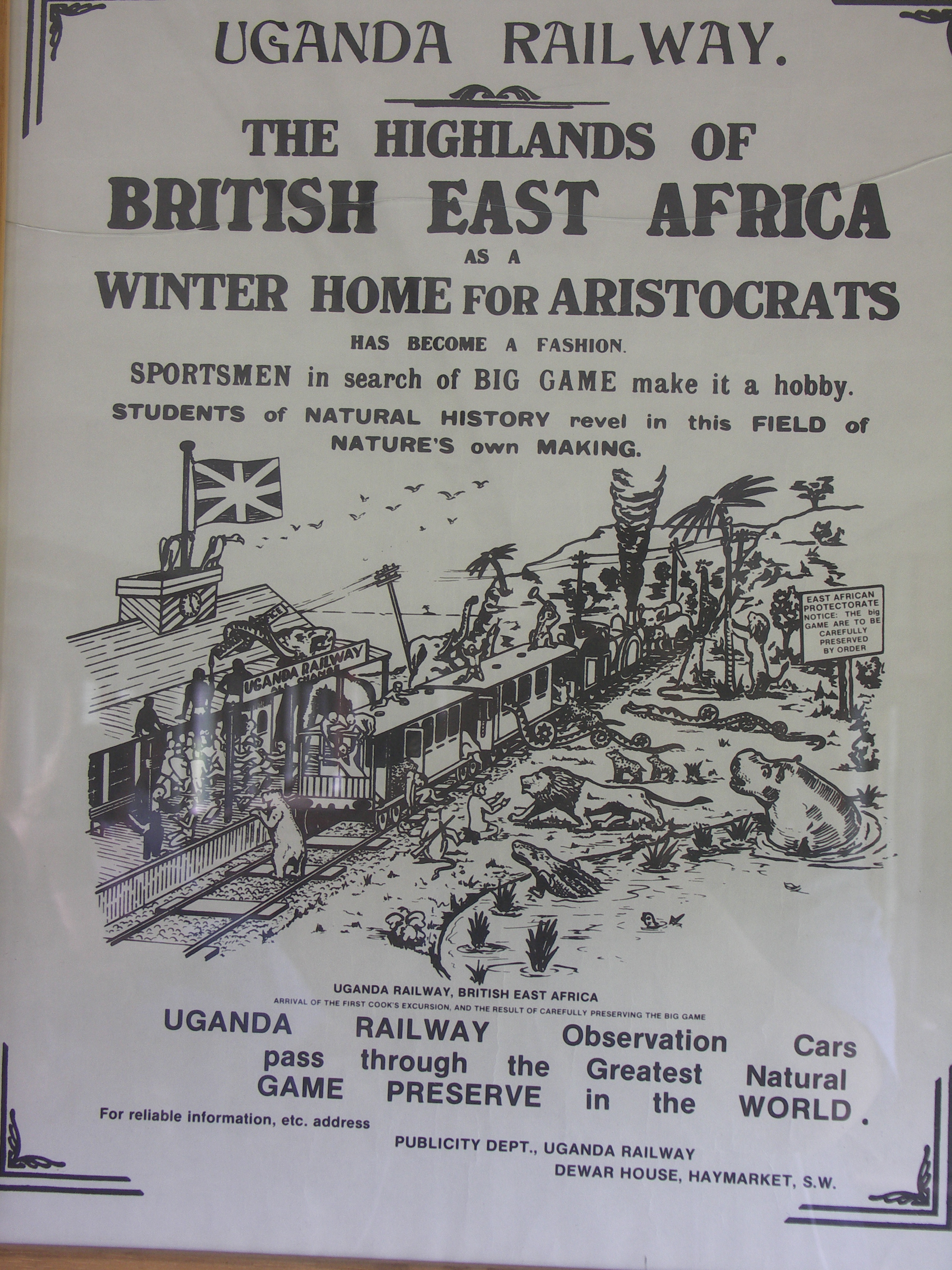
Found some great pictures of the Uganda Railways from the early part of the 20th century.

The source - http://www.sikh-heritage.co.uk/heritage/sikhhert%20EAfrica/sikhsEAfrica.htm


Source - Library of Congress Prints and Photographs Division Washington, D.C. 20540 USA, Carpenter Collection


There's this GREAT poster for the Railways from Wikimedia Commons.