Showing posts with label East Africa. Show all posts

Sunday, February 5, 2012

Shankar's journey - the full map

The journey that Shankar completes in Chander Pahar is an epic one. Starting from Mombasa, in what is now Kenya, he travels through countries in Central Africa, South Africa, Namibia, Zimbabwe, and leaves for India from Beira, in what is now Mozambique.

There may have been longer and more difficult fictional journeys, but I can't recall them. In comparison, the Odyssey is but a short, albeit fraught trip, among the little islands in Greece.

Here's the full map (drawn by me, hence inaccurate and purely indicative) of this journey.


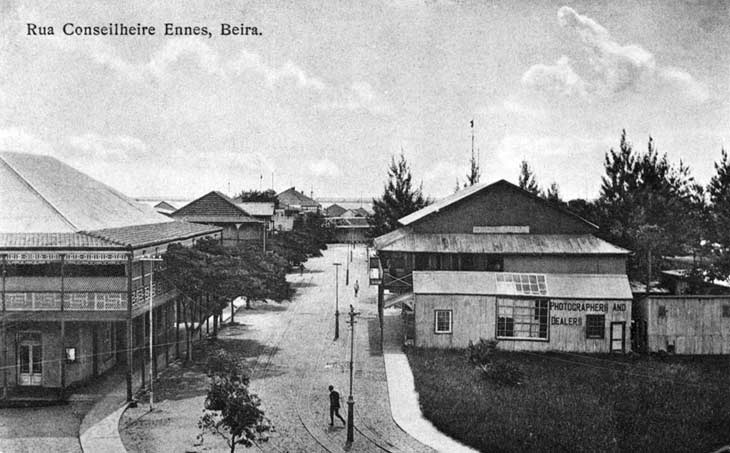
Beira was established in 1890 by the Portuguese and soon became the main port in the Portuguese-administered territory. The Portuguese built the port and a railway to Rhodesia, Portuguese families settled in the newly-founded locality and started to develop commercial activities. Before Mozambique's independence from Portugal, as a city of Portuguese Mozambique, Beira was noted for its well-equipped seaport, one of the major facilities of its kind in all East Africa, tourism, fishing and trade. The city prospered as a cosmopolitan port with different ethnic communities (Portuguese, Indian, Chinese, indigenous Africans) employed in administration, commerce, and industry. During the colonial era, a large English-speaking population was the result of being a favourite holiday destination for white Rhodesians.

I found this picture in Wikipedia - "View of Rua Conseleheira Ennes, Beira, Mozambique. Photograph of original postcard c1905, published by The Rhodesia Trading Co. Ltd., Beira", dated1905.


Perhaps Shankar travelled from Salisbury to Beira in this very train.


(Both these pictures are taken from Wikipedia and rights belong to their various owners).
You could buy my book in Flipkart.com, and other online book stores.

Sunday, December 11, 2011

Which is the REAL Mountain of the Moon?

While reading and translating "Chander Pahar", I was very curious about the real Mountains of the Moon - was there such a place at all?

It turns out that there is indeed such a place. The term Mountains of the Moon or Montes Lunae referred to a mountain range in central Africa that is the source of the White Nile - check this out. However, the real Mountains of the Moon is far away from the final setting of Shankar's adventure; the source of the White Nile is Lake Victoria in Tanzania.

The location of these fabled mountains had been disputed over the centuries. The Scottish explorer, James Bruce identified the Mountains of the Moon with Mount Amedamit in Ethiopia.

G.W.B. Huntingford suggested in 1940 that the Mountain of the Moon should be identified with Mount Kilimanjaro (left - one of the most beautiful mountains in the world), and "was subsequently ridiculed in J. Oliver Thompson's History of Ancient Geography published in 1948". Huntingford later noted that he was not alone in this theory, citing Sir Harry Johnston in 1911 and Dr. Gervase Mathew later in 1963 having made the same identification.


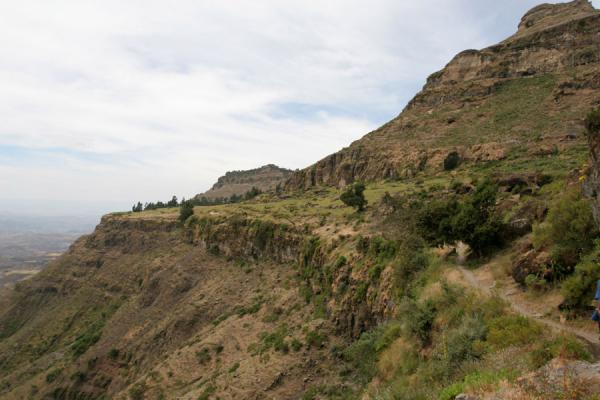
O. G. S. Crawford identified this range with the Mount Abuna Yosef area in the Amhara Region of Ethiopia. The picture on the left is of the path leading to Mekina Medhane Alem church (Lalibela).

"Mountains of the Moon" is also the name of a movie - see here - which tells the story of Captain Richard Francis Burton's and Lt. John Hanning Speke's expedition to find the source of the Nile river in the name of Queen Victoria's British Empire, their meeting, their friendship emerging amidst hardship, and then dissolving after their journey. I haven't seen the movie; this review from Rotten Tomatoes is quite interesting. "Director Bob Rafelson fulfilled a lifelong dream when he finally received backing to complete Mountains of the Moon. The film recreates the exploratory adventures of 19th century visionaries Sir Richard Burton (Patrick Bergin) and John Henning Speke (Iain Glen). The heart of the film is the effort by Burton and Speke to discover the true source of the Nile river. This occurs well into the film, after several torturous scenes involving the injuries sustained by the protagonists during other expeditions and their growing friendship (which, the film intimates, goes far beyond friendship). Rafaelson's fascination with this story, and his insistence upon painstaking historical accuracy, unfortunately compromises his ability to make an interesting film. There are so many starts and stops during the first half that we sincerely hope Burton and Speke will chuck it all and set up a pub in Bristol or something. What saves Mountains of the Moon is the rapport between its stars and the brilliant, epic-like cinematography of Roger Deakins."

Sunday, September 11, 2011

The black mamba

One the scariest moments in Shankar's days in the grasslands of East Africa was his night-time encounter with the black mamba.

According to Wikipedia, its name is derived from the black colouration inside the mouth rather than the actual colour of the skin which varies from dull yellowish-green to a gun-metal grey. It is the fastest snake in the world, capable of moving at 4.32 to 5.4 metres per second (16–20 km/h, 10–12 mph).

This is a really really dangerous creature. How danger can be appreciated when you read this post by Wade Nolan. "On a recent safari to Africa, I hand-caught a wild nine-foot Black Mamba. It was a calculated risk...involving bad calculation.
The Mamba's head is coffin-shaped and the inside of his mouth is an ominous black...he would raise up to near eye level, look aggressively at us then loose his balance... and tip over...only to raise up again..hissing. I thought that maybe he had gotten hold of a bad mouse and was woozy.
I made a hasty and misguided decision to lay hands on the most poisonous snake in the world. Most mamba bites are fatal.  This aggressive cobra has a nasty habit of biting it's victims 4 and 5 times in the face and neck.
The third time he raised up and tipped, I pinned his head, and without a lot of thinking...(I bet that surprises you), I had a very angry Black Mamba in my hand.

From the roof of his gaping open mouth I could see the curved extended fangs. Dripping from those fangs was the deadliest venom in the reptile kingdom... mamba venom is yellow. The slippery venom ran out of the corner of his mouth and into my hand..." 

There's a pretty hairy video of this episode here.
And here's a vid of a black mamba hunting a mouse. A friend said that this is the first time she felt sympathy for a mouse.